
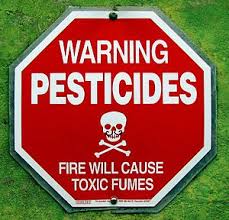
 Once again, a pesticide banned in many other countries due to its harmful effects on humans and the environment, is allowed to be used in the US. The incredibly dangerous pesticide paraquat is banned in more than 70 countries, including China (where it is made), but not the US. Paraquat (paraquat dichloride) is a highly toxic weed killer used by farmers.
Many studies and farmers themselves report that paraquat causes Parkinson's disease. Currently there are thousands of lawsuits against Syngenta, the manufacturer, and Chevron USA (the seller). [NOTE: Of course Syngenta denies any link between paraquat exposure and Parkinson's disease.] The US Geological Survey reports that between 11 million and 17 million pounds of paraquat are sprayed annually on American farms. But here's the crazy part: use of the pesticide in the US is increasing annually. WTH?
By the way, Parkinson’s disease is the fastest growing neurological disorder in the world, with about 90,000 new cases diagnosed each year in the US. A number of pesticides are linked with the increase, with the link between paraquat and Parkinson's disease known since the 1980s (by research done by independent researchers). Evidence is growing that it's not just direct exposure (contact with it), but also chronic low level exposure that is linked to Parkinson's disease (e.g., living near a farm - thus inhalation of low levels in the air).
What will it take to ban the use of paraquat in the US? (Yes, there are alternatives to paraquat.) Doesn't look likely in the near future. In fact, the chemical/pesticide industry is trying to pass state and federal laws that would protect pesticide manufacturers from liability.
Excerpts from an investigative piece. From nj.com news: Thousands of U.S. farmers have Parkinson’s. They blame a deadly pesticide.
Paul Friday remembers when his hand started flopping in the cold weather – the first sign nerve cells in his brain were dying.
With evidence of its harms stacking up, it’s already been banned in dozens of countries all over the world, including the United Kingdom and China, where it’s made. Yet last year, its manufacturer Syngenta, a subsidiary of a company owned by the Chinese government, continued selling paraquat in the United States and other nations that haven’t banned it.
It has many critics wrestling with the question: What will it take to ban paraquat in the United States?
Krause is one of thousands of people who have sued Syngenta, a manufacturer, and Chevron USA, a seller, over paraquat exposure. They’re alleging the chemical companies failed to warn of the dangers of paraquat despite knowing it could damage human nerve cells and studies showing it’s linked to Parkinson’s disease.
In Ohio, there’s Dave Jilbert a winemaker who sprayed the pesticide on his vineyard south of Cleveland. He was diagnosed with Parkinson’s in 2020 and now he is suing and working to get paraquat banned. Terri McGrath believes years of exposure to paraquat at her family farm in rural Southwest Michigan likely contributed to her Parkinson’s. Six other family members also have the disease. And in south Alabama, Mac Barlow is suing after receiving a similar diagnosis following years of relying on paraquat.
Since hitting the market in the 1960s, paraquat has been used in farming to quickly “burn” weeds before planting crops. The pesticide, originally developed by Syngenta and sold by Chevron, rips tissue apart, destroying plants on a molecular level within hours.
Because paraquat kills any growth it touches, it’s typically used to clear a field before any crops are planted. Low levels of paraquat residue can linger on food crops, but the foremost threat is direct exposure.
The U.S. Environmental Protection Agency already restricts paraquat, labeling it as “registered use,” with a skull and crossbones, meaning it can only be used by people who have a license. Because of its toxicity, the federal government requires it to have blue dye, a sharp smell and a vomiting agent, according to the U.S. Centers for Disease Control, CDC. Sprayers are also told to wear protective gear.
Even secondary exposure can be dangerous. One case published in the Rhode Island Medical Journal described an instance where a 50-year-old man accidentally ingested paraquat, and the nurse treating him was burned by his urine that splashed onto her forearms. Within a day, her skin blistered and sloughed off.
Meanwhile, a much more widespread threat looms large in the background: long-term, low-level exposure.
Parkinson’s disease is the fastest growing neurological disorder in the world, with cases projected to double by 2050, partly due to an aging population, according to a study published in The BMJ, a peer-reviewed medical journal. It occurs when the brain cells that make dopamine, a chemical that controls movement, stop working or die.
That’s why Dorsey, who literally wrote the book on Parkinson’s, calls the disease “largely preventable.” There’s a long list of environmental factors linked to Parkinson’s, but pesticides are one of the biggest threats, according to Dorsey. “If we clean up our environment, we get rid of Parkinson’s disease,” he said.
An early 1987 case report published in Neurology discusses the case of a 32-year-old citrus farmer who started experiencing tremors, stiffness and clumsiness after 15 years of spraying paraquat. But “a cause-and-effect relationship is difficult to establish,” a doctor wrote at the time.
Critics point to other epidemiological studies being more definitive. In 2011, researchers studied farmworkers exposed to two pesticides, rotenone and paraquat, and determined those exposures increased the risk of developing Parkinson’s by 150%. Another study, published last year, looked at 829 Parkinson’s patients in central California. It found people who live or work near farmland where paraquat is used have a higher risk of developing the disease.
This is a growing concern in American suburbs where new houses press up against well-maintained golf courses. A study published in JAMA this year found that living within a mile of a golf course increased the risk of Parkinson’s disease by 126%. It didn’t name specific chemicals but did point to pesticides.
A trove of internal documents released during litigation, as reported by The Guardian and the New Lede, appeared to show that the manufacturers were aware of evidence that paraquat could collect in the brain.
The trail of bread crumbs started as early as 1958 when a company scientist wrote about a study of 2.2 dipyridyl, a chemical in paraquat, saying it appears to have moderate toxicity “mainly by affecting the central nervous system, and it can be absorbed through the skin,” the internal documents said.
The internal documents show by 1974, the company updated safety precautions, recommending that anyone spraying the pesticide wear a mask, as there were the first reports of human poisoning and concerns about the effects of paraquat started to grow.