
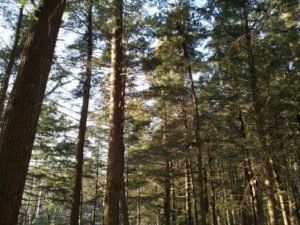
 Not only humans and many foods (e.g., fruits) have microbiomes - the community of bacteria, viruses, archaea, and fungi living on and in the organism. Researchers found that trees also have microbiomes, and when a tree is diseased, the microbiome changes.
A single tree can be home to a trillion microbial cells! The microbes interact and depend on each other.
Additionally, different tree species have different microbiomes, and different parts of the tree have different microbiomes - the tree bark (sapwood) vs tree interior(heartwood). Makes sense!
Excerpts from NY Times: In Every Tree, a Trillion Tiny Lives
Scientists have found that a single tree can be home to a trillion microbial cells — an invisible ecosystem that is only beginning to be understood.
A forest is a complex, dynamic ecosystem in which a rich array of living things, from old-growth trees to microscopic fungi, interact and depend on one another for survival.
So is the inside of a tree, it turns out.
Earlier this month, a team of scientists published the most comprehensive study of the microbiomes living inside tree trunks. Their findings suggest that the woody tissues of trees contain a trillion microbial cells above and beyond actual tree cells: communities of bacteria and single-celled organisms called archaea that have specialized to different parts of the tree and even to individual tree species.
The study’s results, published in the journal Nature, reveal a vast and largely unexplored reservoir of microbial diversity. “A tree individual is sort of a complex ecosystem in and of itself,” said Jonathan Gewirtzman, an ecosystem ecologist at Yale University and an author of the study.
He noted that while the research is still in its early stages, it was “sort of impossible” that some of these microbes weren’t crucial to a tree’s health, growth and immunological resilience.
The team sampled more than 150 trees across 16 species in the Northeastern United States. They extracted wood cores, all thinner than a pen, from red maples, black birches, white ash trees and more. Then, the team tried out a variety of methods — grinding, blending, beating the wood samples — to extract the DNA and estimate the microbial population in the tree trunks.
Microbes can live in two different parts of the tree trunk: the outer wood, known as sapwood, and the inner wood, known as heartwood. The new study found that each region has its own community of microbes. Sapwood is dominated by microbes that require oxygen, whereas heartwood is dominated by microbes that don’t. Much of the methane produced by a tree originates from the heartwood, the study found.
Dr. McDonald studies how a deadly oak disease known as acute oak decline changes the microbiome of oak trees. A better understanding of the microbiome of specific tree species could help scientists predict how the trees will respond to various diseases, he said.
The study found that tree microbiomes differed from species to species. Sugar maples, known for producing maple syrup, had more sugar-eating bacteria, whereas others, like the oak trees used for wine barrels, harbored a microbial group known to aid fermentation. Such examples demonstrate how tree microbes affect “our everyday lives in sort of unexpected ways,” said Wyatt Arnold, a microbial ecologist and an author on the study.
How do microbes get inside the tree’s woody tissues? Some might be inherited through seeds and retained into a tree’s adulthood, while others might enter through wounds or natural openings. Still others might arrive through routes that scientists haven’t yet discovered.