The human gut microbiota spans the tree of life and includes bacteria, viruses, and eukaryotes such as fungi, helminths, and protozoa. ...The observation that the gut bacterial microbiome is less diverse in populations from industrialized countries, compared to nonindustrialized countries, has been mostly explained by differences in dietary fiber intake, food sterilization, and the use of antibiotics. Here, we propose that the decreased prevalence of helminths and gut protozoa in industrialized countries is partly responsible for this loss of bacterial diversity.
We argue, based on the knowledge of helminths, that some intestinal protozoa might have beneficial effects on their host through their influence on the gut bacterial microbiome. The role of protozoa in shaping the gut microbiome of healthy individuals remains, however, largely unrecognized. The mechanisms through which protozoa influence the gut bacteria – and the consequences for human health of their absence in developed countries – are poorly understood and call for further attention.
The question is therefore whether gut eukaryotes are simply parasites that are detrimental to human health or whether, on the contrary, they could provide, after millions of years of coevolution, some beneficial effects to their hosts. Historically, protozoa and helminths have been considered parasites and assumed to have a detrimental effect on the host organism. Indeed, foodborne and waterborne parasitic diseases are important worldwide, resulting in considerable morbidity and mortality. However, while the focus remains on pathogens that have been investigated from a parasitological point of view, the eukaryotic residents of the gut are often commensal (i.e., benefiting from interacting with the host without affecting it) or even beneficial.
For example, even though some helminths can cause severe illness, infections are often asymptomatic, probably reflecting a long coevolutionary history (since at least 500 million years) and tolerance of these parasites by humans. Similarly, although the best-known protozoan microorganisms found in the human gut are pathogens (i.e., Cryptosporidium spp., Giardia intestinalis, Entamoeba histolytica), it is important to remember that many protozoa, in particular Blastocystis spp., can be found with high prevalence in healthy populations, and are common (and likely ancient) members of healthy microbiomes. Indeed, although protozoan cysts are not as resistant to decay as helminth eggs, they can be found in coprolites, confirming that protozoa, like helminths, were part of our ancestral gut community.
Interestingly, recent findings also showed that the presence of commensal protozoa (Entamoeba spp. other than Entamoeba histolytica) was strongly associated with increased diversity and various shifts in composition of the gut bacterial microbiota in rural nonindustrialized populations. Higher diversity has also been found in subjects carrying Blastocystis spp., one of the few protozoa to be present at appreciable frequency in industrialized populations. These results suggest similarities between helminths and protozoa in their effect on the gut bacterial microbiome, and raise the possibility of a potentially beneficial effect of (some) protozoa on human health.
Here, we argue that some intestinal protozoan inhabitants could play an important, yet largely unrecognized, role in shaping the gut bacterial microbiota and in maintaining the host–microbe equilibrium, and they should be considered as ‘friends’ of the human gut.

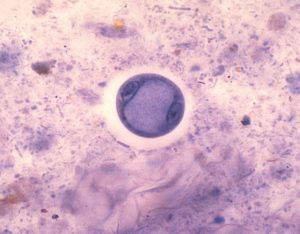 Entamoeba coli - a non-pathogenic species that frequently lives as a commensal parasite in the human gastrointestinal tract. Credit: Wikipedia.

