
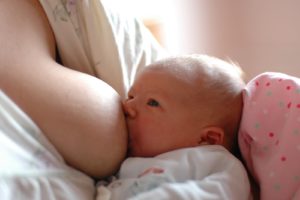
Credit: Wikimedia Commons/ Anton Nosik
It has long been known that breast milk contains hundreds of microbial species (the milk microbiome), which help seed the infant's gut microbiome. Over the weeks and months of breast feeding, the microbial species in the milk change. All this is normal and good.
A recent study of human breast milk examined the species in breast milk and found that that the species could be viewed as a microbial ecosystem - one that is important in helping seed the infant's gut. The milk contained species that are considered beneficial (e.g., Bifidobacterium), but also some that can be viewed as not beneficial (e.g., E.coli). The milk was from healthy mother-infant pairs, so it was clear that this variety was normal.
Researchers analyzed 507 breast milk and infant stool samples from 195 healthy mother-infant pairs at one, three, and six months postpartum. They found characteristic mixes of bacteria dominated by Bifidobacteria (especially B. longum, B. breve, and B. bifidum). More than half of the milk samples contained B. longum, and that same species was abundant in over 98% of the infants' gut microbiomes.
The paper mentioned that numerous times they found the exact same bacterial strain in both the mother and infant pairs - thus evidence that the mothers transmitted that bacteria to the babies in the breast milk (this is referred to as vertical transmission).
From Medical Xpress: Breast milk microbes help shape infants' gut microbiomes, study finds
Most conversations about breast milk tend to focus on topics like nutrients, antibodies and bonding time rather than bacteria. But it turns out that human milk carries its own tiny community of microbes, and those passengers may help shape a baby's developing gut microbiome—which in turn can impact nutrient absorption, metabolic regulation, immune system development, and more.
A study published in Nature Communications provides one of the most detailed portraits yet of how different combinations of bacteria in human milk contribute to the assembly of infants' gut microbiomes.
"Breast milk is the recommended sole source of nutrition for an infant's first months of life, but important questions about the milk microbiome remained unanswered because the analytical challenges are intimidating," said first author Pamela Ferretti, Ph.D., a postdoctoral researcher in the Blekhman Lab at the University of Chicago. "We decided to tackle this endeavor because our collaboration presented a unique opportunity to combine key resources."
Those resources included hundreds of milk samples collected as part of the Mothers and Infants LinKed for Healthy Growth (MILK) study, led by Ellen Demerath, Ph.D., at the University of Minnesota and by David Fields, Ph.D., at the Oklahoma University Health Sciences Center.
On the UChicago side, Ferretti and her colleagues had access to metagenomic tools and deep experience with microbiome data, including Ferretti's highly specific expertise in infant microbiomes and transmission analysis. In her previous research, she studied how different maternal body sites—such as mouth, skin, and vaginal cavity—contributed to infant microbiomes.
Analyzing 507 breast milk and infant stool samples from 195 mother–infant pairs, the team found that breast milk contained a distinct mix of bacterial species dominated by the genus bifidobacteria, including Bifidobacterium longum, B. breve, and B. bifidum. More than half of the milk samples carried B. longum, a species abundant in over 98% of the infants' gut microbiomes.
"Metagenomic analysis is trickier and more complicated, but it really paid off because it allowed us to obtain information at the level of different bacterial strains—which is key, because that's the only level where we could actually claim to know about transmission," Ferretti said.
The paper reported 12 instances in which the same exact strain was found in a mother's breast milk and in the gut of her infant, which is a very strong indication that the transmission happens vertically via breastfeeding.
Some of these shared strains were beneficial commensal species, such as B. longum and B. bifidum, which help digest human milk sugars and support healthy gut development. Others, however, were pathobionts—microbes like E. coli and Klebsiella pneumoniae that can live harmlessly in healthy individuals but have the potential to cause infection under certain conditions.
The authors note that all mothers and infants in the study were healthy, indicating that the presence of these species in milk does not inherently signal disease, but rather reflects the microbial diversity that can be transferred during breastfeeding.
Interestingly, the team also saw specific strains of bacteria usually associated with the mouth—such as Streptococcus salivarius and Veillonella species—in milk samples. They realized this as potential evidence of "retrograde flow" during breastfeeding: as the baby feeds, tiny amounts of oral bacteria may travel back into the nipple and ducts and become part of the milk microbiome.