
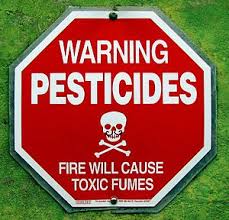
 Stories about the toxic pesticide paraquat keep coming. Paraquat is a herbicide (weed-killer) that is strongly associated (causes) Parkinson's disease plus other health harms. This pesticide is banned in over 70 countries world-wide due to its known health harms, but not the US.
California recently took steps to ban the pesticide, but people in New York state are also demanding a ban. The Guardian recently wrote an investigative piece describing the elevated incidence of Parkinson's disease among residents in the rural farming community of Hebron in upstate NY.
The residents want a state-wide ban on the use of paraquat. They say that too many of them have developed Parkinson's disease due to the use of paraquat in their area.
Paraquat is a herbicide (weed-killer) that is strongly linked to (causes) Parkinson's disease, and is known to damage the lungs, kidneys. liver, cardiac system, and other bodily systems. While it is banned in more than 70 countries world-wide (e.g., the EU, China, UK, Brazil), the EPA reapproved its use in 2024. More than 10 million pounds annually are sprayed on US crops (e.g., soybeans, almonds, walnuts, cotton).
Excerpts from the Guardian: The herbicide haunting a New York farm town
Gordon Chaplin gingerly stepped out of the car at the top of the steep hill behind his farmhouse, sporting a bandage on his hand from a fall the day before. He gripped his cane as he shuffled through the knee-high grass. He stopped every few feet to catch his breath, leaning on his caregiver for support.
“Things just don’t work as well as they used to. In fact, sometimes they don’t work at all,” said Chaplin, 81, who has owned the farm for over 40 years. “There’s nothing worse than having your whole life … falling apart.”
Nearly a decade ago, he began experiencing symptoms he couldn’t explain. His once-pristine handwriting became unreadable, his face took on a permanent look of worry, and he acted out his dreams while he slept. After years of inconclusive test results from various doctors, he received a diagnosis: he had Parkinson’s disease, an incurable degenerative brain disease that affects motor functions and causes cognitive impairment. He had no family history or genetic predisposition to the disease.
Chaplin and his wife, Sarah Teale, believe the cause lay hidden under the idyllic hills of their 200-acre cattle and corn farm. For decades, a tenant farmer sprayed the land with paraquat, a herbicide that’s used to kill broadleaf weeds and grasses – and that research has linked to Parkinson’s.
The couple lives in Hebron, a rural farming town of about 1,800 residents in Washington county. After Chaplin’s diagnosis, Teale discovered that 14 people near their home had the disease, too. She calls the seven-mile stretch of highway between east and west Hebron “Parkinson’s Valley”. In nearby towns, she found dozens more. And she believes there’s a common culprit.
Paraquat is banned in dozens of countries and is coming under heavier scrutiny in the US. This year, 14 states introduced bills to restrict or ban its use. Vermont was the only state to pass a ban. New York lawmakers sought to be the second, but the bill died on the floor amid a prolonged budget standoff that crowded out other legislation.
“Hundreds of bills that we would normally pass never got a vote because we ran out of time,” said assembly member and bill sponsor Linda Rosenthal. “More people will suffer between now and when this bill becomes law. You can bet I’m going to work really hard to make sure it passes the next session.”
The scientific debate over paraquat’s safety has been building for decades. Studies dating back to the late 1990s have linked paraquat exposure to Parkinson’s disease. A 2002 study found that mice injected with paraquat lost dopamine neurons, a hallmark of Parkinson’s. A 2011 study found that farmers who sprayed paraquat were 2.5 times as likely to develop Parkinson’s as those who did not. A 2024 study found that people living or working near areas sprayed with paraquat had double the risk of developing Parkinson’s.
Research linking paraquat to Parkinson’s is “one of the strongest databases out there linking a chemical exposure to a disease”, said Deborah Cory-Slechta, a University of Rochester neurotoxicologist.
Ray Dorsey, a neurologist at the Atria Research and Global Health Institute, said it’s a common misconception that people with Parkinson’s developed it primarily because of ageing or genetics. About 85% of Americans with Parkinson’s carry no known genetic risk factor for the disease, he said.
“The principal causes of Parkinson’s disease are not inside of us, not in our DNA, but outside of us, in our environment,” said Dorsey, who published a book on the disease last year that identified Hebron as a hotspot. “The continued use of paraquat is likely sowing the future seeds of Parkinson’s disease.”
The herbicide has been banned in over 70 countries, including China, Brazil and the entire European Union. But not the United States.
Last November, the [EPA] agency said it would require paraquat manufacturers to study how far paraquat vapors travel from the initial spray site. That announcement came after Syngenta, one of the world’s largest producers of paraquat, submitted new data that suggested vapors may travel miles farther than previously thought.
The company, based in Switzerland, stood by the product’s safety.
Just about everyone in Hebron knows someone touched by Parkinson’s, residents told New York Focus during a visit to the town last month.
In 2024, Teale hosted a town hall for families in the area affected by the disease. The room had a maximum occupancy of 60 people. About 85 people piled in.
New York state doesn’t publish town-level Parkinson’s data. But Brian Campbell, Hebron’s town supervisor, said there were far more cases than there should be. His own father died of Parkinson’s after living with the disease for more than 30 years.
Thousands of Americans have filed lawsuits against Syngenta, which sells paraquat under the brand name Gramoxone, alleging that the company failed to warn consumers about paraquat’s substantial health risks.
In 2022, the Guardian and the New Lede published internal documents revealing that Syngenta was aware of the mounting research linking the herbicide to Parkinson’s disease. The company monitored scientists studying the links, lobbied the EPA to bar critical scientists from sitting on advisory panels, strategized ways to “influence academia, and regulatory and NGO environments”, and created a team to respond to external scientific publications.
The overall goal, the internal documents revealed, was “to protect people and our reputation”.
When New York lawmakers try to enact a ban next year, they will go up against the New York Farm Bureau, the state’s largest agriculture advocacy group and one of the lead opponents of the bill. The group did not respond to repeated requests for comment.