
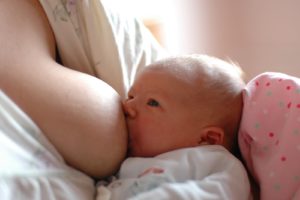
Credit: Wikimedia Commons/ Anton Nosik
It has long been known that breast milk contains hundreds of microbial species (the milk microbiome), which help seed the infant's gut microbiome. Over the weeks and months of breast feeding, the microbial species in the milk change. All this is normal and good.
A recent study of human breast milk examined the species in breast milk and found that that the species could be viewed as a microbial ecosystem - one that is important in helping seed the infant's gut. The milk contained species that are considered beneficial (e.g., Bifidobacterium), but also some that can be viewed as not beneficial (e.g., E.coli). The milk was from healthy mother-infant pairs, so it was clear that this variety was normal.
Researchers analyzed 507 breast milk and infant stool samples from 195 healthy mother-infant pairs at one, three, and six months postpartum. They found characteristic mixes of bacteria dominated by Bifidobacteria (especially B. longum, B. breve, and B. bifidum). More than half of the milk samples contained B. longum, and that same species was abundant in over 98% of the infants' gut microbiomes.
The paper mentioned that numerous times they found the exact same bacterial strain in both the mother and infant pairs - thus evidence that the mothers transmitted that bacteria to the babies in the breast milk (this is referred to as vertical transmission).
From Medical Xpress: Breast milk microbes help shape infants' gut microbiomes, study finds
Most conversations about breast milk tend to focus on topics like nutrients, antibodies and bonding time rather than bacteria. But it turns out that human milk carries its own tiny community of microbes, and those passengers may help shape a baby's developing gut microbiome—which in turn can impact nutrient absorption, metabolic regulation, immune system development, and more. ...continue reading "Breast Milk Transmits Important Bacteria to the Infant Gut Microbiome"