Skip to content

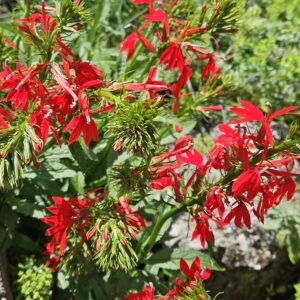
Cardinal flower

Haven't seen any bees or butterflies this past week. Not on flowers, not among the clover. None. All I can do is document the devastating effects of neighboring pesticide applications on pollinator populations in my organic suburban property.

A neighbor has had numerous applications by 3 services(!) for several years - on the lawn, in the garden, on plants around the house, the exterior of the house, and the hedges between properties. Basically everywhere, typically every 3 weeks. Of course, the pesticides drift to neighboring properties (mine!).

The worst for pollinators (bees, butterflies) appear to be the mosquito applications using a device that looks like a leaf blower, which is held at waist-height - these are high-volume applications. The mosquito applications are done using cypermethrin and pyrethroid insecticides (which are synthetic pesticides, e.g., made by Fendona). Pyrethroids are known to be highly toxic to pollinators such as bees and wasps, and there is growing evidence of harms to humans (herehere).

One study confirmed that pesticides are a major reason that wild bee populations are significantly down in the US. The researchers found that bee species are about 43% down in areas of heavy pesticide use. They singled out pesticides (insecticides) such as neonicotinoids and pyrethroids as drivers of this bee species reduction. They pointed out that using Integrated Pest Management (IPM) or organic methods would help reduce pesticide use and so help with bee species populations.

This means that businesses (e.g., Mosquito Joe) that apply long-lasting pyrethroids throughout suburban yards and hedges in the US are contributing directly to bee species reduction.

Other studies found that applying pesticides (no matter what kind) to lawns destroys bee populations and reduces the number of bee species. Think of lawns that are not treated with pesticides as having wildflowers, not weeds. These are bee habitats!
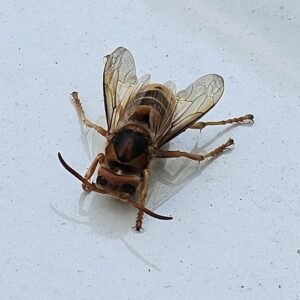
Dying pollinator

There was a rare sighting of an insect pollinator in my yard recently. Unfortunately, it was dying. I suspect that pesticides were the cause of the slow death.

The ordinary person has no clue how damaging pesticide applications on their lawns and plants can be to insects living nearby. To pollinators (e.g., bees and wasps). To entire insect and bird ecosystems.

On the day I saw the dying insect pollinator, an immediate neighbor had not one, but two pesticide applications by two different services in one day! One service was for their lawn, and the second one was for mosquitos (using pyrethroid and cypermethrin insecticides) with a device that looks like a leaf blower. This device is held at waist-height (a high volume application).

Soon after that I found the dying, but still twitching, pollinator on the hood of my car (close to the property line). As I've discussed before, since the neighbor started mosquito pesticide applications 2 years ago, I rarely see a bee, wasp, or butterfly in my organic yard. At most, maybe one bee every 2 months? Before that, there were many daily.

The mosquito applications are done using cypermethrin and pyrethroid insecticides (which are synthetic pesticides, e.g., made by Fendona). Pyrethroids are known to be highly toxic to pollinators such as bees and wasps, and there is growing evidence of harms to humans (here, here).

Of course, when pesticides are applied, they drift and travel to non-target neighboring areas. It's sad. But totally legal.

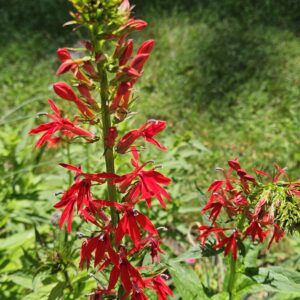
Cardinal flowers    Credit: M. Silgailis

Hummingbirds like the red Cardinal flower (also called lobelia). Really like them. Butterflies also swarm to these flowers. Usually.

But not always. Since an immediate neighbor started using a mosquito service that uses high-volume pesticide applications of a synthetic pyrethroid (think of a leaf blower on steroids), there has been an absence of butterflies, bees, and hummingbirds in my garden. Other people also report this happening.

Even though the synthetic pyrethroids (e.g., Fendona) are not neonicotinoids, which we know kills bees - pyrethroids are also toxic to bees. Pyrethroids are broad-spectrum insecticides - that is, they kill a wide variety of insects indiscriminately. This totally destroys the biodiversity of species in the environment. We need bees, butterflies, hummingbirds, and other species!

But what are the pesticides doing to humans? Developing children? The developing fetus? Sick people? Everyone? Yes, there is accumulating evidence of health harms to humans, especially children and babies.