
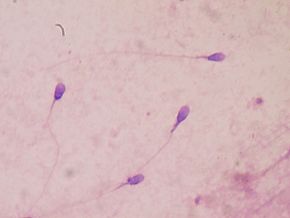
 Recent research looked at environmental causes of male infertility, specifically endocrine-disrupting chemicals. Poor semen quality contributes to increases in infertility and the use of assisted reproductive technology.The researchers also discuss the higher incidence of testicular cancer worldwide, lower levels of testosterone in men, and poor semen quality among men aged 20 to 25 (with the average man having up to 90% abnormal sperm). From Science Daily:
Endocrine-disrupting chemicals may be threatening fertility in industrialized countries
The birth rate is declining in all industrialised countries, and socioeconomic factors and women's age are not solely to blame. Male reproductive health and environmental factors are also significant, as concluded in a new scientific review article. ...Behind the article are fertility researchers from Denmark, the US and Finland. The researchers studied a number of factors related to fertility, and one of the main conclusions of their study was that poor semen quality contributed to increases in infertility and the use of assisted reproductive technology.
The study also revealed higher incidence of testicular cancer worldwide, with the greatest frequency among Caucasian populations. Moreover, the researchers also observed lower levels of testosterone in average men. "I was surprised that we found such poor semen quality among young men aged 20 to 25. The average man had up to 90% of abnormal sperm. Normally, there would be so many sperms that a few abnormal ones would not affect fertility. However, it appears that we are at a tipping point in industrialised countries where poor semen quality is so widespread that we must suspect that it results in low pregnancy rates," said first author of the article, Professor Niels E. Skakkebaek from the Department of Growth and Reproduction (EDMaRC) at Rigshospitalet and the University of Copenhagen.
"The article also demonstrates the impact of the increasing number of male reproductive problems on low birth rates. There is no doubt that environmental factors are playing a role. These are the correlations we are researching at the new research centre EDMaRC at Rigshospitalet," added Professor Anders Juul, who is the last author of the article.
Many of the male reproductive problems could be due to damage to the testes during embryonic development. While the reproductive problems could arise from genetic changes, "recent evidence suggests that most often they are related to environmental exposures of the fetal testes," the researcher team wrote."Since the disorders in male genitals have increased over a relatively short period of time, genetics alone cannot explain this development. There is no doubt that environmental factors are playing a role and that endocrine-disrupting chemicals, which have the same effect on animals, are under great suspicion. The exposure that young people are subjected to today can determine not only their own, but also their children's, ability to procreate," explained Professor Skakkebaek.
 More and more studies are finding negative health effects from hormone disrupting chemicals (which we are exposed to every single day, and subsequently which are in all of us), such as parabens, phthalates, Bisphenol-A (BPA), and chemical substitutes for BPA such as Bisphenol-S (BPS) and BPF. The following are a few recent studies and one article from my files. Also check out the other endocrine disrupting chemical studies I've posted (SEARCH: 'endocrine disruptors', and 'phthalates').
 An interesting Canadian study that followed young children for 3 years found that young infants may be more likely to develop allergic
  Children exposed to insecticides (pesticides) at home have an increased risk of developing leukemia or lymphoma, a new review finds.The analysis, of 16 studies done since the 1990s, found that children exposed to indoor insecticides had an elevated risk of developing the blood cancers. There was also a weaker link between exposure to weed killers and the risk of leukemia.
 Disturbing results from a study looking at data from over 1 million women enrolled in Medicaid before pregnancy from 2000 to 2007. More than four of five (82.5%) pregnant women were prescribed at least one medication, and 42.0% were prescribed a drug that is potentially harmful to the developing fetus.From Medscape:
 Several recent studies have found that constant exposure to high levels of air pollution has negative effects on the brain. The
  There is growing evidence that women around a lot of endocrine disrupting chemicals at home or in jobs such as cleaners, hairdressers and laboratory workers during pregnancy are more likely to have baby boys with a genital defect called
 Another good reason to breastfeed. Exposure to pollutants like nitrogen dioxide and airborne particles can cause negative effects on motor and mental development in infants, but a new study says those effects are countered in babies who are breast-fed for at least 4 months by their mothers. Researchers in Spain began monitoring rural, pregnant women in 2006 and analyzed samples from 638 women and their infants at 15 months. They reported that babies who are breast-fed did not suffer from the potentially harmful developmental impact of PM2.5 (pollution particle matter) and NO2 (nitrogen dioxide). From Science Daily:
 In a newly published study looking at how infant gut microbes change over time, once again babies had differences in gut bacteria depending on whether they were delivered vaginally or by Cesarean section.