Skip to content

Currently, during birth there are many potential disruptions to the healthy development of the infant's microbial ecosystem. Some practices to be concerned about: the use of antibiotics during pregnancy and during delivery, c-sections, newborns routinely given antibiotics, and then bottle feeding instead of breastfeeding. Sometimes one or more of these practices are medically necessary, but currently they are being done much too frequently and casually. In these ways we are conducting an experiment on every baby's microbial ecosystem with unknown long-term consequences. The following excerpts from Dr.Martin Blaser's popular 2014 book Missing Microbes: How the Overuse of Antibiotics Is Fueling Our Modern Plagues, even though written a year ago, are a nice summary of these issues. From Wired:

The Way You’re Born Can Mess With the Microbes You Need to Survive

THROUGHOUT THE ANIMAL kingdom, mothers transfer microbes to their young while giving birth....And for millennia, mammalian babies have acquired founding populations of microbes by passing through their mothers’ vagina. This microbial handoff is also a critical aspect of infant health in humans. Today it is in peril.

Microbes play a hidden role in the course of every pregnancy. During the first trimester, certain species of bacteria become overrepresented while others become less common. By the third trimester, just before the baby is born, even greater shifts occur. These changes, involving scores of species, are not random. The compositions change in the same direction across the dozens of women who have been studied.... Women of reproductive age carry bacteria, primarily lactobacilli, which make the vaginal canal more acidic. This environment provides a hardy defense against dangerous bacteria that are sensitive to acid. Lactobacilli also have evolved a potent arsenal of molecules that inhibit or kill other bacteria.

Whether the birth is fast or slow, the formerly germ-free baby soon comes into contact with the lactobacilli. The baby’s skin is a sponge, taking up the vaginal microbes rubbing against it. The first fluids the baby sucks in contain mom’s microbes, including some fecal matter.

Once born, the baby instinctively reaches his mouth, now full of lactobacilli, toward his mother’s nipple and begins to suck. The birth process introduces lactobacilli to the first milk that goes into the baby. This interaction could not be more perfect. Lactobacilli and other lactic acid–producing bacteria break down lactose, the major sugar in milk, to make energy. The baby’s first food is a form of milk called colostrum, which contains protective antibodies. The choreography of actions involving vagina, baby, mouth, nipple, and milk ensures that the founding bacteria in the baby’s intestinal tract include species that can digest milk for the baby.

Breast milk, when it comes in a few days later, contains carbohydrates, called oligosaccharides, that babies cannot digest. But specific bacteria such as Bifidobacterium infantis, another foundational species in healthy babies, can eat the oligosaccharides. The breast milk is constituted to give favored bacteria a head start against competing bacteria.

Cesarian delivery is a largely unrecognized threat to the microbial handoff from mother to child. Instead of traveling down the birth canal picking up lactobacilli, the baby is surgically extracted from the womb through an incision in the abdominal wall....For all of these reasons, U.S. C-section rates increased from fewer than one in five births in 1996 to one in three births in 2011—a 50 percent increase.

The founding populations of microbes found on C-section infants are not those selected by hundreds of thousands of years of human evolution. A few years ago in Puerto Ayacucho, Venezuela, my wife, Gloria, conducted the first study of its kind to test whether the microbes found on newborn babies delivered vaginally or by C-section varied in any way....The mouths, skin, and first bowel movements of babies born vaginally were populated by their mother’s vaginal microbes: Lactobacillus, Prevotella, or Sneathia species. Those born by C-section harbored bacterial communities found on skin, dominated by Staphylococcus, Corynebacterium, and Propionibacterium.

In other words, their founding microbes bore no relationship to their mother’s vagina or any vagina. At all the sites—mouth, skin, gut—their microbes resembled the pattern on human skin and organisms floating in the air in the surgery room. They were not colonized by their mother’s lactobacilli. The fancy names of these bacteria don’t matter as much as the notion that the founding populations of microbes found on C-section infants are not those selected by hundreds of thousands of years of human evolution or even longer.

Another threat to a baby’s newly acquired resident microbes involves antibiotics given to the mother. Most doctors consider it safe to prescribe penicillins for all sorts of mild infections in pregnancy—coughs, sore throats, urinary tract infections. Sometimes when doctors think that the mother has a viral infection they also give antibiotics just in case it is actually a bacterial infection.

Then comes the birth itself. Women in labor routinely get antibiotics to ward off infection after a C-section....Antibiotics are broad in their effects, not targeted....The problem, of course, is that we know antibiotics are broad in their effects, not targeted. While the antibiotic kills Group B strep, it also kills other often-friendly bacteria, thus selecting for resistant ones. This practice is altering the composition of the mother’s microbes in all compartments of her body just before the intergenerational transfer is slated to begin.

The baby also is affected in similar unintended ways. Any antibiotic that gets into the bloodstream of the fetus or into the mother’s milk will inevitably influence the composition of the baby’s resident microbes, but we are only beginning to understand what this means.

Finally, the babies are directly exposed. Most parents are not aware that all American-born babies today are given an antibiotic immediately after birth. The reason is that many years ago, before antibiotics, women who unknowingly had gonorrhea would pass the infection to their babies, giving the newborns terrible eye infections that could cause blindness...The dose is low but is likely affecting the composition of the infant’s resident microbes just when the founding populations are developing. We should be able to develop a better way to screen, so we can target those babies at the highest risk, perhaps a few hundred among the millions of births a year.

Although babies are born into a world replete with diverse bacteria, the ones that colonize them are not accidental. These first microbes colonizing the newborn begin a dynamic process. We are born with innate immunity, a collection of proteins, cells, detergents, and junctions that guard our surfaces based on recognition of structures that are widely shared among classes of microbes. In contrast, we must develop adaptive immunity that will clearly distinguish self from non-self. Our early-life microbes are the first teachers in this process, instructing the developing immune system about what is dangerous and what is not.

A newborn infant, seconds after delivery. Amniotic fluid glistens on the child's skin.  Credit: Wikipedia, Ernest F

Research is accumulating that the microbial exposure from a vaginal birth, breastfeeding, and pets in the first year of life are all good for a baby's developing immune system and the gut microbiome.
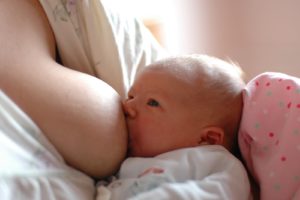
From Science Daily: Breastfeeding, other factors help shape immune system early in life

Researchers say that breastfeeding and other factors influence a baby's immune system development and susceptibility to allergies and asthma by what's in their gut. The striking findings from a series of studies further advance the so-called hygiene hypothesis theory that early childhood exposure to microorganisms affects the immune system's development and onset of allergies, says Christine Cole Johnson, Ph.D., MPH, chair of Henry Ford's Department of Public Health Sciences and principal research investigator.

The gut microbiome is the collection of microorganisms in the gastrointestional, or GI, tract, and the human body has billions of these microbes... The gut microbiome is known to play an important role in immune system development, and is thought to contribute to a host of diseases like obesity, autoimmune diseases, circulating disorders and pediatric allergies and infection.

"For years now, we've always thought that a sterile environment was not good for babies. Our research shows why. Exposure to these microorganisms, or bacteria, in the first few months after birth actually help stimulate the immune system," Dr. Johnson says."The immune system is designed to be exposed to bacteria on a grand scale. If you minimize those exposures, the immune system won't develop optimally."

In six separate studies, researchers sought to evaluate whether breastfeeding and maternal and birth factors had any effect on a baby's gut microbiome and allergic and asthma outcomes. Using data collected from the WHEALS birth cohort, researchers analyzed stool samples from infants taken at one month and six months after birth. They also looked at whether the gut microbiome impacted the development of regulatory T-cells, or Treg, which are known to regulate the immune system. Highlights:

Breastfed babies at one month and six months had distinct microbiome compositions compared to non-breastfed babies. These distinct compositions may influence immune system development.Breastfed babies at one month were at decreased risk of developing allergies to pets. • Asthmatic children who had nighttime coughing or flare-ups had a distinct microbiome composition during the first year of life. • For the first time, gut microbiome composition was shown to be associated with increasing Treg cells.

Researchers found that a baby's gut microbiome patterns vary by: • A mother's race/ethnicity. • A baby's gestational age at birth. • Prenatal and postnatal exposure to tobacco smoke. • Caesarean section versus vaginal delivery.• Presence of pets in the home.

Henry Ford's landmark 2002 study found exposure to dogs or cats in the first year of a baby's life reduced their risk for allergies.

More long-term benefits from breastfeeding. The first study finds that long-term it's as good or better than statins! From Science Daily:

Birthweight and breastfeeding have implications for children's health decades later

Young adults who were breastfed for three months or more as babies have a significantly lower risk of chronic inflammation associated with cardiovascular and metabolic diseases, according to research from the Brown School at Washington University in St. Louis.

"This study shows that birthweight and breastfeeding both have implications for children's health decades later," said Molly W. Metzger, PhD, assistant professor at the Brown School and a co-author of the study with Thomas W. McDade, PhD, of Northwestern University.

"Specifically, we are looking at the effects of these early factors on later levels of C-reactive protein (CRP), a biomarker associated with risk for cardiovascular and metabolic disease," Metzger said. "Comparing the long-term effects of breastfeeding to the effects of clinical trials of statin therapy, we find breastfeeding to exert effects that are as large or larger."

The researchers used data from the U.S. National Longitudinal Study of Adolescent Health, including parent surveys, and blood samples providing measurements of CRP. These findings held up in a series of sibling models, in which one sibling was breastfed and the other was not. Such models provide improved confidence in the results by implicitly controlling for genetic factors for elevated CRP.

This study was published a year ago (Aug. 2013) and shows a long-term benefit to the mother (reduced Alzheimer's risk) of breastfeeding. From Science Daily:

Breastfeeding may reduce Alzheimer's risk

Mothers who breastfeed their children may have a lower risk of developing Alzheimer's Disease, with longer periods of breastfeeding also lowering the overall risk, a new study suggests.

The report, newly published in the Journal of Alzheimer's Disease, suggests that the link may be to do with certain biological effects of breastfeeding. For example, breastfeeding restores insulin tolerance which is significantly reduced during pregnancy, and Alzheimer's is characterised by insulin resistance in the brain.

Another reason to breastfeed infants. From Medical Xpress:

Breastfeeding promotes the growth of beneficial bacteria in the gut

A number of studies have shown that breastfed babies grow slightly slower and are slightly slimmer than children who are fed with infant formula. Children who are breastfed also have a slightly lower incidence of obesity, allergies, diabetes and inflammatory bowel disease later in life. According to a new study by the National Food Institute and the University of Copenhagen this may be due to the fact that breastfeeding promotes the development of beneficial bacteria in the baby's gut.

"We have become increasingly aware of how crucially important a healthy gut microbial population is for a well-functioning immune system. Babies are born without bacteria in the gut, and so it is interesting to identify the influence dietary factors have on gut microbiota development in children's first three years of life," research manager at the National Food Institute Tine Rask Licht says.

The study shows that there are significant changes in the intestinal bacterial composition from nine to 18 months following cessation of breastfeeding and other types of food being introduced. However, a child's gut microbiota continues to evolve right up to the age of three, as it becomes increasingly complex and also more stable.

"The results help to support the assumption that the gut microbiota is not - as previously thought - stable from the moment a child is a year old. According to our study important changes continue to occur right up to the age of three.

More information: The study has been described in a scientific article in Applied and Environmental Microbiology: Establishment of intestinal microbiota during early life: A longitudinal, explorative study of a large cohort of Danish infants:www.ncbi.nlm.nih.gov/pubmed/24584251

Breast milk contains hundreds of species of bacteria.From the December 8, 2013 Scientific American:

The bacteria in breast milk

Several recent studies have found that breast milk contains a healthy dose of commensal bacteria; all the staphylococci, streptococci, and lactic acid bacteria that are found in the infant gut. This isn’t just bacteria from the skin which have contaminated the samples, but bacteria that have come from inside the breast as an integral component of the milk.

In a study of 16 women it was found that while each milk sample contained hundreds of different bacterial species, around half of the microbiotic community was made up of nine species present in all samples. The other half varied from person to person. This pattern is also found in human gut microbes; a core set present in all individuals along with a large diversity of separate species to make up a unique individual microbiome.

So how do bacteria get into breast milk? Some of them may come from the mouth of the baby. During feeding the skin of both the mother and baby will be in contact with the baby’s open mouth and a certain amount of flow-back can occur between the mouth and nipple. More excitingly it’s been suggested that immune cells in the mothers gut may be able to pick up bacteria and carry them around the body using the lymphatic system. The lymphatic system is a network of vessels used to transport blood plasma. It’s a main highway for immune cells inside the body and is also involved in the absorption and transports of fats.

Like all humans, infants have a range of bacteria within their gut. It looks like these bacteria are initially supplied from the mother’vaginal and skin bacteria, before being replaced by bacteria from the breast milk. Researchers also found that when babies started eating solid food a whole new range of bacteria was introduced, forming the gut microbiome that persisted into adulthood.