
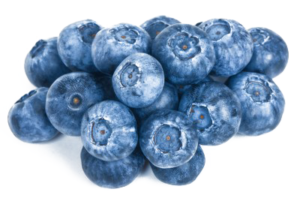
 A new study was published that supports eating lots of blueberries (or drinking blueberry juice) for health - this time better brain functioning in people aged 65 to 77 who drank concentrated blueberry juice daily for 12 weeks. The people randomly assigned to the group drinking blueberry juice daily showed improvements in cognitive function, blood flow to the brain, and activation of the brain while carrying out cognitive tests. The people received MRIs (magnetic resonance imaging), as well as various blood tests and cognitive tests.
And how much did they drink of the juice daily? Thirty ml or 1 ounce of blueberry concentrate (which provided 387 mg anthocyanins) which was diluted with tap water. Anthocyanins are anti-oxidants that belong to a class of compounds called flavonoids, and are found in high concentrations in blueberries, cherries, and plums. The blueberry concentrate amount was equivalent to about 230 grams of blueberries - about 1 1/3 cups blueberries.
What was good about the study was that to eliminate bias people were both randomly assigned to the blueberry juice group or a placebo group (they drank a synthetic fruit cordial) - and it was "double-blind" so that no one knew who was in which group. Interestingly, people who were already eating more than 5 portions of fruits daily were excluded from the study - because so many other studies have already found all sorts of brain benefits from a diet with lots of fruits and berries. But the main conclusion from this and other related research is: eating lots of berries is good for you and has health benefits. From Medical Xpress:
Blueberry concentrate improves brain function in older people
Drinking concentrated blueberry juice improves brain function in older people, according to research by the University of Exeter. In the study, healthy people aged 65-77 who drank concentrated blueberry juice every day showed improvements in cognitive function, blood flow to the brain and activation of the brain while carrying out cognitive tests. There was also evidence suggesting improvement in working memory. Blueberries are rich in flavonoids, which possess antioxidant and anti-inflammatory properties.
Of the 26 healthy adults in the study, 12 were given concentrated blueberry juice - providing the equivalent of 230 g of blueberries - once a day, while 14 received a placebo. Before and after the 12-week period, participants took a range of cognitive tests while an MRI scanner monitored their brain function and resting brain blood flow was measured. Compared to the placebo group, those who took the blueberry supplement showed significant increases in brain activity in brain areas related to the tests. The study excluded anyone who said they consumed more than five portions of fruit and vegetables per day, and all participants were told to stick to their normal diet throughout. [Original study.]
 This post continues the discussion of antibiotics and their overuse. Antibiotic resistance is increasing due to misuse of antibiotics (or antimicrobials), and this is occurring throughout the world (
 Could this be true? Probiotics for seasonal allergies? A
  It's now 4 years being free of chronic sinusitis and off all antibiotics! Four amazing years since I (and then the rest of my family) started using easy do-it-yourself sinusitis treatments containing the probiotic (beneficial bacteria) Lactobacillus sakei. My sinuses feel great! And yes, it still feels miraculous.
 Many posts on this blog are about beneficial microbes, and the many species of microbes (bacteria, fungi, viruses) living within and on us. But there are also bacteria in the world that pose a serious threat to human health, and the list of these are growing due to antibiotic resistance. This week the World Health Organization (WHO) officials came out with a list of a dozen antibiotic-resistant "priority pathogens" that pose the greatest threats to human health. These are bacteria resistant to multiple antibiotics - thus superbugs.
 This past week a study was published linking 8 to 10 portions of fruits and vegetables per day with a lower risk of early death, cancer, heart disease, and stroke. This confirms other research linking many daily servings of fruits and vegetables with various health benefits. For example, the study findings discussed in the
  Do you want to live longer and be healthy at the same time? Some possible ways may be to restrict the calories in the diet (every day) or to practice intermittent calorie restriction (a fasting mimicking diet a few days a month or even each week, such as
  A recent study had great results in preventing glaucoma or stopping the progress of glaucoma by supplementing the diet of mice with vitamin B3 (nicotinamide). But now the research needs to see if this also holds true for humans.
 A new study has summarized what we know about fungi that live in and on babies - and yes, we all have fungi both on and within us. It's called the mycobiome. In healthy individuals all the microbes (bacteria, viruses, fungi, etc) live in balanced microbial communities, but the communities can become "out of whack" (dysbiosis) for various reasons, and microbes that formerly co-existed peacefully can multiply and become problematic. Or other pathogenic microbes can enter the community, and the person becomes ill.