
 This study found something surprising in many samples of human breast tissue - bovine leukemia virus (BLV). Specifically, 59 percent of breast cancer tissue samples had evidence of exposure to BLV (as determined by the presence of viral DNA using modern genetic tests). In contrast, 29 percent of the tissue samples from women who did not have breast cancer (the controls) showed exposure to BLV. Also, BLV was found in 38% of women with premalignant breast tissue changes. The big question: is the bovine leukemia virus somehow leading to breast cancer? That would mean that some breast cancers have a viral origin (and a vaccine can be developed). No one knows this answer, and now more studies need to be done. But....the odds of having breast cancer if BLV was present was 3.1 times greater than if BLV was absent. It also raises the question of whether those women showing exposure with BLV, but currently no breast cancer, are at higher risk for later breast cancer. Stay tuned... From Medical Xpress:
Virus in cattle linked to human breast cancer
A new study by University of California, Berkeley, researchers establishes for the first time a link between infection with the bovine leukemia virus and human breast cancer. In the study, published this month in the journal PLOS ONE and available online, researchers analyzed breast tissue from 239 women, comparing samples from women who had breast cancer with women who had no history of the disease for the presence of bovine leukemia virus (BLV). They found that 59 percent of breast cancer samples had evidence of exposure to BLV, as determined by the presence of viral DNA. By contrast, 29 percent of the tissue samples from women who never had breast cancer showed exposure to BLV.
"The association between BLV infection and breast cancer was surprising to many previous reviewers of the study, but it's important to note that our results do not prove that the virus causes cancer," said study lead author Gertrude Buehring, a professor of virology in the Division of Infectious Diseases and Vaccinology at UC Berkeley's School of Public Health. "However, this is the most important first step. We still need to confirm that the infection with the virus happened before, not after, breast cancer developed, and if so, how."
Bovine leukemia virus infects dairy and beef cattle's blood cells and mammary tissue. The retrovirus is easily transmitted among cattle primarily through infected blood and milk, but it only causes disease in fewer than 5 percent of infected animals. A 2007 U.S. Department of Agriculture survey of bulk milk tanks found that 100 percent of dairy operations with large herds of 500 or more cows tested positive for BLV antibodies. This may not be surprising since milk from one infected cow is mixed in with others. Even dairy operations with small herds of fewer than 100 cows tested positive for BLV 83 percent of the time.
What had been unclear until recently is whether the virus could be found in humans, something that was confirmed in a study led by Buehring and published last year in Emerging Infectious Diseases. That paper overturned a long-held belief that the virus could not be transmitted to humans."Studies done in the 1970s failed to detect evidence of human infection with BLV," said Buehring. "The tests we have now are more sensitive, but it was still hard to overturn the established dogma that BLV was not transmissible to humans. As a result, there has been little incentive for the cattle industry to set up procedures to contain the spread of the virus."
The new paper takes the earlier findings a step further by showing a higher likelihood of the presence of BLV in breast cancer tissue. When the data was analyzed statistically, the odds of having breast cancer if BLV were present was 3.1 times greater than if BLV was absent. "This odds ratio is higher than any of the frequently publicized risk factors for breast cancer, such as obesity, alcohol consumption and use of post-menopausal hormones," said Buehring.
There is precedence for viral origins of cancer. Hepatitis B virus is known to cause liver cancer, and the human papillomavirus can lead to cervical and anal cancers. Notably, vaccines have been developed for both those viruses and are routinely used to prevent the cancers associated with them. "If BLV were proven to be a cause of breast cancer, it could change the way we currently look at breast cancer control," said Buehring. "It could shift the emphasis to prevention of breast cancer, rather than trying to cure or control it after it has already occurred."
Buehring emphasized that this study does not identify how the virus infected the breast tissue samples in their study. The virus could have come through the consumption of unpasteurized milk or undercooked meat, or it could have been transmitted by other humans.
 A recent post (
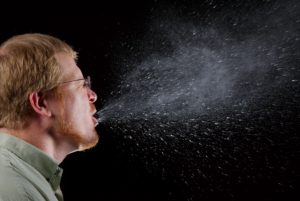 Amazing! We each release a "personal microbial cloud" with its own "microbial cloud signature" every day. The unique combination of millions of bacteria (from our microbiome or community of microbes - including bacteria, viruses, fungi - that live within and on us) can identify us. Not only do we each give off a unique combination, but we each give off different amounts of microbes - some more, some less. Some very common bacteria: Streptococcus, Propionobacterium, Corynebacterium, and Lactobacillus (among women).The microbes are given off with every movement, every exhalation, every scratching of the head, every burp and fart, etc. - and they go in the air around the person and settle around the person (they researchers even collected bacteria from dishes set on the ground around the person). From Science Daily:
 Sneeze. Credit: Wikipedia and CDC
 Perhaps a nutrient deficit is associated with depression? This study found that eating a Mediterranean diet or a similar diet in which fruits, vegetables, legumes (beans), nuts, and low in processed meats is associated with lower rates of depression. From Medical Xpress:
 Children exposed to insecticides (pesticides) at home have an increased risk of developing leukemia or lymphoma, a new review finds.The analysis, of 16 studies done since the 1990s, found that children exposed to indoor insecticides had an elevated risk of developing the blood cancers. There was also a weaker link between exposure to weed killers and the risk of leukemia.
 It's official - the medical community has accepted that a key element in preventing allergies and asthma is early childhood exposure to allergens - whether peanuts, dust, or pets
 Another study found that young children who more time spent outside in natural light for 3 years resulted in fewer cases of myopia (near-sightedness). Specifically, the good results were found from one additional 40-minute class of outdoor activities each school day, as well as parents encouraging their children to play outdoors after school hours, especially during weekends and holidays. So....those of you who are parents of children huddled inside - get them outside daily in the sunlight to soak up sunshine for vitamin D and to help their vision. From Science Daily:
 More research support for extra virgin olive oil and the Mediterranean diet being associated with anti-cancer effects, In a study conducted in Spain, women supplementing their diet with extra EVOO (extra virgin olive oil) had a lower incidence of breast cancer after about 5 years.
 Yes, even healthy newborns have a diversity of viruses in the gut - this is their