
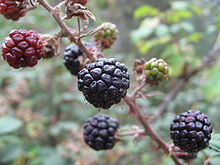
 It seems that a lot has been written about the health benefits of some berries, such as blueberries, while other berries have been neglected. This study focused on red raspberries, black raspberries, and blackberries. While the study was done in Poland, it was pointed out that these berries are also commonly grown in the USA. Red raspberry, black raspberry, and blackberry fruits are abundant in dietary phytochemicals such as flavonols, phenolic acids, ellagitannins, vitamins C and E, folic acid, and β-sitosterol. Many of these bioactive compounds exhibit antioxidant activity. Anthocyanins and other phenolic compounds such as ellagitannins and ellagic acid, which distinguish raspberry from other berries, occur in high levels and are mainly responsible for their broad beneficial health properties (including anti-inflammatory, antimicrobial, and antiviral activities).
For these reasons, the researchers said that "raspberry and blackberry fruits can be regarded as natural functional foods". Another term for functional foods is nutraceutical, which is a food containing health-giving additives and having medicinal benefit. From Science Daily:
Looking for the best antioxidant fruit? Search no further than black raspberries
As far as healthy foods go, berries make the top of the list. They contain potent antioxidants, which decrease or reverse the effects of free radicals -- natural byproducts of energy production that can play havoc on the body and that are closely linked with heart disease, cancer, arthritis, stroke or respiratory diseases.
Unsurprisingly, the benefits of berries are extoled in one study after another....The research published now in Open Chemistry suggests that black raspberries grown in Central Europe show greater health benefits than their better known cousins -- raspberries or blackberries.
A group of researchers led by Anna Małgorzata Kostecka-Gugała measured the content of phenolics and anthocyanins in black raspberries, red raspberries and blackberries, assessing their antioxidant potential and health benefits. They were able to confirm that the antioxidant activity of natural products correlates directly with their health promoting properties.
It turns out that the amount of antioxidants in black raspberries was three times higher than the other fruits under investigation. Remarkably, the number was even higher for phenolics or the amount of anthocyanines -- with black raspberries topping their humble cousins by over 1000%. But most interestingly, black raspberries seem to be characterized by a higher content of secondary metabolites, which have been proved beneficial for human health.
 Reading this recent study, I was struck by how the results are evidence for eating sulforaphane containing foods, such as kale, cauliflower, brussels sprouts, broccoli, and cabbage for health and preventing cancer (due to anti-tumor activity). It is debatable whether it is support for taking supplements (here a sulforaphane supplement called BSE), even though the researchers were testing the supplement. Seven days of taking a supplement without "serious adverse events" (but they did have minor ones such as "mild abdominal discomfort") is too short a length of time for any support for a product. The real test would be seeing what health effects, both positive and negative, are after a year or two of taking the supplement.
 Just a few years ago the type of pesticide (organophosphate, for example chlorpyrifos) looked at in this study was commonly used everywhere - in schools, homes, agriculture. It was easy to buy in stores (e.g., Raid spray), and was considered "safer" than older pesticides. Over time problem after problem has been found with them - with the latest being decreased lung function in children exposed to organophosphates early in life.
 The mother is an important source of the first microbiome for infants by "seeding" the baby's microbiome - from the
  New research showed that eight days after a concussion, the concussed athletes (football players) looked and felt like they had recovered (clinical recovery), but MRIs showed that there were still neurophysiological abnormalities (significant blood flow decrease) in their brains. They did not look at if and when the blood flow returned to normal, but that research also needs to be done.
 This new study gives further support for the role of the appendix as a "natural reservoir for 'good' bacteria". The researchers found that a network of immune cells (innate lymphoid cells or ILCs) safeguard the appendix during a bacterial attack and help the appendix "reseed" the gut microbiome. They also said that a person's diet, such as the proteins in leafy green vegetables, could help produce ILCs. Note that while it is thought that this applies to humans, the research was done on mice. From Medical Xpress:
 Loneliness or social isolation is a health risk that can increase the risk of chronic illness and premature death.
 Cold and flu season will soon be here, so it's time to review sneeze basics. Here's a nice little study looking at where our sneeze germs wind up - answer: basically all over the room within a "high propulsion sneeze cloud". From Medical Xpress;
 Another excellent reason to breastfeed premature infants - to increase the odds of preventing retinopathy of prematurity (ROP), which is the reason preemies can go blind. It occurs when blood vessels in the retinas of premature infants start to grow out of control. If the abnormal growth continues, the retinas detach, and this can cause blindness.