
 Get active, really active, to reduce your risk for 5 diseases: breast cancer, colon cancer, heart disease, and ischemic stroke. Instead of the 150 minutes of brisk walking or 75 minutes per week of running (which is equal to the 600 metabolic equivalent (MET) minutes now recommended by the World Health Organization), this study found that much more exercise is needed for best health results.
This study (which was a review and analysis of 174 studies) found that there is a dose-response effect, with the most reduction in the risk of the 5 conditions by getting 3000 to 4000 MET minutes per week. This sounds like a lot, but the researchers point out that this can be achieved by incorporating exercise into your daily routines. The researchers write: "A person can achieve 3000 MET minutes/week by incorporating different types of physical activity into the daily routine—for example, climbing stairs 10 minutes, vacuuming 15 minutes, gardening 20 minutes, running 20 minutes, and walking or cycling for transportation 25 minutes on a daily basis would together achieve about 3000 MET minutes a week."
So start thinking creatively about how to increase exercise or activity into your daily life, especially moderate or vigorous intensity activity. For example, park your car far from the store door, or better yet, bicycle or walk to the store from home. From Medscape:
Get Moving: High Physical-Activity Level Reduces Risk of 5 Diseases
High levels of physical activity can reduce the risk for five major diseases, including type 2 diabetes, new research shows. Findings from the systematic review and meta-analysis were published online ....The data, from a total 174 studies comprising 149,184,285 total person-years of follow-up, suggest that the more total regular daily physical activity one engages in — including recreation, transportation, occupational activity, and/or daily chores — the lower the risks for breast cancer, colon cancer, diabetes, ischemic heart disease, and ischemic stroke.
However, significant reductions in those conditions were seen only with total activity levels considerably higher than the minimum 600 metabolic equivalent (MET) minutes per week recommended by the World Health Organization for health benefits. That 600 METs equates to about 150 minutes/week of brisk walking or 75 minutes/week of running. (A MET is defined as the ratio of the metabolic rate during that activity to the metabolic rate when resting.) Risks of the five conditions dropped significantly with an increase in MET minutes per week from 600 to 3000 to 4000, with less additive benefit seen above that level.
For reference, the authors say, "a person can achieve 3000 MET minutes/week by incorporating different types of physical activity into the daily routine — for example, climbing stairs 10 minutes, vacuuming 15 minutes, gardening 20 minutes, running 20 minutes, and walking or cycling for transportation 25 minutes on a daily basis would together achieve about 3000 MET minutes a week." "This amount might seem a bit large, but this is about total activity across all domains of life.…For people who currently don't exercise, clinicians could encourage them to incorporate physical activity into their daily routines, [such as] turning household chores into exercise.
Another recent meta-analysis of trials involving more than one million individuals indicated that an hour of moderate-intensity activity, such as brisk walking or cycling, offsets the health risks of 8 hours of sitting. The message that physical inactivity is a killer — leading to 5.3 million premature deaths annually worldwide, which is as many as caused by smoking and twice as many as associated with obesity, has been emerging over the past few years, with warnings that "sitting is the new smoking."
This new research is the first meta-analysis to quantify the dose-response association between total physical activity across all domains and the risk of five chronic diseases. The 174 prospective cohort studies included 35 for breast cancer, 19 for colon cancer, 55 for diabetes, 43 for ischemic heart disease, and 26 for ischemic stroke. (Some included more than one end point.)....Higher levels of total physical activity were associated with lower risks of all five outcomes.
With the development of diabetes, for example, compared with no physical activity, those with 600 MET minutes per week (the minimum recommended level of activity) had a 2% lower risk. That risk reduction jumped by an additional 19% with an increase from 600 to 3600 METs/week. Gains were smaller above that, with the increase of total activity from 9000 to 12,000 MET minutes/week yielding only an additional 0.6% diabetes reduction.
Overall, compared with insufficiently active individuals (total activity < 600 MET minutes/week), the risk reduction for those in the highly active category (≥ 8000 MET minutes/week) was 14% for breast cancer; 21% for colon cancer; 28% for diabetes; 25% for ischemic heart disease; and 26% for ischemic stroke.
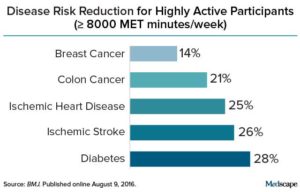 Credit: Medscape
 A medical article in the journal Addiction states that there is strong evidence that alcohol causes 7 cancers, that there is evidence that it probably causes more, the effects are dose related, and if one
  Another excellent reason to lose weight if you are overweight or obese: losing weight (through diet or through combined diet and exercise) significantly lowers levels of proteins in the blood that help cancerous tumors grow. In other words, reducing weight could turn out to be a cancer prevention method in overweight and obese persons. Exercise alone did not lower the levels of these cancer-associated proteins.
 Yup, according to a new mega-study, being overweight or obese is linked to higher risk of dying prematurely than being normal weight. And the more you weigh, the greater the risk.
 Surprising study results. The question is why would having higher education somehow be associated with higher incidence of brain tumors? Is there something about sitting and studying, or sitting in an office for hours on end - perhaps next to something with high electromagnetic fields, that leads to this result? Or is it what a
  A second study was just published about the benefits of eating whole grains daily - again a significantly lower risk of premature death, and again the effects were dose-related. That is, the more whole grains eaten daily, the lower the risk of early death. Like the
  Surprising results (to me at least) from research comparing various diets and incidence of several cancers in 11,082 individuals in the Netherlands over a 20 year period. I expected the daily meat eaters to have higher rates of the 3 cancers studied, but no....
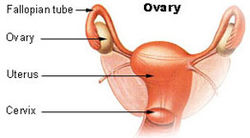 Another community of microbes found in humans in areas once thought to be sterile (without bacteria) - the ovaries and fallopian tubes in the female upper reproductive tract. And the interesting thing is that once again we see differences in the bacterial communities of areas with and without cancer (here the ovaries). From Science Daily: