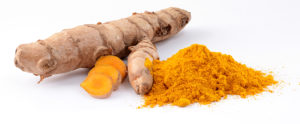
 The spice turmeric is very popular these days, especially because studies link it to various health benefits. But is this true? Is it better to eat turmeric in foods or take it in pill form as a supplement? Today's post is about a study that was done by the BBC teaming up with researchers at Newcastle University (in the UK) where they looked at whether modest doses of turmeric had health benefits when ingested daily for 6 weeks. Specifically, they looked at what turmeric does to various blood markers thought to be associated with inflammation and changes that could eventually lead to the onset of cancer. It is currently thought that many or turmeric's supposed health benefits come from the compound curcumin found in it.
The researchers took blood samples of 100 volunteers, who were then split up into 3 groups (turmeric powder, a turmeric pill, or a placebo pill daily). Only the group that ingested turmeric in powder form (1 teaspoon mixed in food) showed changes after 6 weeks, and they were exciting beneficial changes in the methylation of DNA. This is because "methylation of the DNA can ‘go wrong’ and this can cause cells to become cancerous".
It's still early days in this research, and more has to be done, but it is exciting. In the meantime, don't take turmeric in pill form, but eat it in foods. It seems that more of the turmeric gets absorbed when eaten with foods, especially foods with fat, and also with a little black pepper. Excerpts from the article written by Michael Mosley, one of the presenters of the broadcast show "Trust Me, I'm A Doctor", from the BBC News:
Could turmeric really boost your health?
Turmeric is a spice which in its raw form looks a bit like ginger root, but when it's ground down you get a distinctive yellowy orange powder that's very popular in South Asian cuisine.....So we tracked down leading researchers from across the country and with their help recruited nearly 100 volunteers from the North East to do a novel experiment. Few of our volunteers ate foods containing turmeric on a regular basis.
Then we divided them into three groups. We asked one group to consume a teaspoon of turmeric every day for six weeks, ideally mixed in with their food. Another group were asked to swallow a supplement containing the same amount of turmeric, and a third group were given a placebo, or dummy pill. The volunteers who were asked to consume a teaspoon of turmeric a day were ingenious about what they added it to, mixing it with warm milk or adding it to yoghurt. Not everyone was enthusiastic about the taste, with comments ranging from "awful" to "very strong and lingering".
But what effect was eating turmeric having on them? We decided to try and find out using a novel test developed at University College, London, by Prof Martin Widschwendter and his team....There are at least 200 different compounds in turmeric, but there's one that scientists are particularly interested in. It gives this spice its colour. It's called curcumin. Thousands of scientific papers have been published looking at turmeric and curcumin in the laboratory - some with promising results. But they've mainly been done in mice, using unrealistically high doses. There have been few experiments done in the real world, on humans.
Prof Widschwendter is not particularly interested in turmeric but he is interested in how cancers start. His team have been comparing tissue samples taken from women with breast cancer and from women without it and they've found a change that happens to the DNA of cells well before they become cancerous. The change is in the "packaging" of the genes. It's called DNA methylation. It's a bit like a dimmer switch that can turn the activity of the gene up or down. The exciting thing is that if it is detected in time this change can, potentially, be reversed, before the cell turns cancerous.
So we asked Prof Widschwendter whether testing the DNA methylation patterns of our volunteers' blood cells at the start and end of the experiment would reveal any change in their risk of cancer and other diseases, like allergies. It was something that had not been done before. Fortunately he was very enthusiastic. "We were delighted," he said, "to be involved in this study, because it is a proof of principle study that opens entirely new windows of opportunity to really look into how we can predict preventive measures, particularly for cancer."
So what, if anything, happened? When I asked him that, he pulled out his laptop and slowly began to speak."We didn't find any changes in the group taking the placebo," he told me. That was not surprising. "The supplement group also didn't also show any difference," he went on. That was surprising and somewhat disappointing.
"But the group who mixed turmeric powder into their food," he continued, "there we saw quite substantial changes. It was really exciting, to be honest. We found one particular gene which showed the biggest difference. And what's interesting is that we know this particular gene is involved in three specific diseases: depression, asthma and eczema, and cancer. This is a really striking finding."
It certainly is. But why did we see changes only in those eating turmeric, not in those taking the same amount as a supplement? Dr Kirsten Brandt, who is a senior lecturer at Newcastle University and who helped run the experiment, thinks it may have something to do with the way the turmeric was consumed. "It could be," she told me, "that adding fat or heating it up makes the active ingredients more soluble, which would make it easier for us to absorb the turmeric.....She also told me, because our volunteers all tried consuming their turmeric in different ways, that we can be confident it was the turmeric that was making the difference and not some other ingredient used to make, say, chicken tikka masala. There is a lot more research that needs to be done, including repeating the experiment to see if these findings can be confirmed.
More information about the study and results from BBC News: Does turmeric really help protect us from cancer?

 Many of us grew up having silver colored dental fillings (called dental amalgam) in our teeth. Dental amalgam has been used for over 150 years for the treatment of dental cavities (caries) because it is durable, easy to use, and affordable. But it is composed of about 50% elemental mercury (Hg) and so it may release a certain amount of mercury both during the time the cavity is filled and afterward with normal wear. Mercury can cause adverse health effects, such as effects on the central nervous system, kidneys, and immune system. Human mercury exposure also occurs through the consumption of mercury (MeHg) contaminated seafood.
 Monosodium glutamate is an additive used as a "flavor enhancer" that has long been used in foods (processed and packaged foods, as well as fast food and restaurant meals) - and it has also been controversial for decades. Even four decades ago some people complained of headaches after having foods with added monosodium glutamate, and since then health complaints have just increased. Since so much is still unknown about the health effects of additives commonly added to foods, then many people just want to avoid them. But it's tricky because manufacturers sneak monosodium glutamate into foods using various other name such as hydrolyzed vegetable protein, autolyzed yeast, glutamic acid, and yeast extract.
 New research shows that the most applied pesticide in the world - glyphosate - is being detected in more and more foods (such as honey, wheat). Glyphosate is a herbicide (weed killer) found in the product Roundup. Its use is increasing annually due to its use on crops genetically engineered to tolerate applications of the herbicide ("Roundup Ready" corn, soybeans, canola).
 The most amusing study that I've read in a while, but hey, if it works - why not? Bottom line: Riding certain types of roller coasters (such as Big Thunder Mountain at Disney World) enables some people to pass kidney stones. Kidney stones are small, hard mineral deposits that form inside the kidneys, affecting up to 15 percent of people in developed countries.
 We all know that exercise is beneficial for health. Research suggests that exercising out in nature is best for several varied reasons - including that it
  Exciting
  This study reinforces (once again) that actively playing with toy blocks is good for developing the spatial skills and spatial abilities of children. Other studies have shown that playing with
 The big scary question: What will happen after antibiotics cease to work? And people start dying by the millions from infections that used to be easily treated? We are fast approaching that point of total antibiotic resistance, with superbugs that resist all antibiotics. More and more disease-causing bacteria are rapidly evolving immunity to every existing antibiotic (see