
 New research found that one course of antibiotics (ciprofloxacin, clindamycin, amoxicillin or minocycline) had varying effects on the gut and saliva microbes, with ciprofloxacin having a negative and disruptive effect on gut microbiome diversity up to 12 months. While the microscopic communities living in the mouth rebound quickly, just one course of antibiotics can disrupt the gut microbiome for months - with amoxicillin the least and ciprofloxacin the most (up to a year).The researchers stressed that for these reasons "antibiotics should only be used when really, really necessary. Even a single antibiotic treatment in healthy individuals contributes to the risk of resistance development and leads to long-lasting detrimental shifts in the gut microbiome."
The scary part is that Americans typically take many courses of antibiotics throughout life. And people with conditions such as chronic sinusitis typically take many more than average. From Medical Xpress:
One course of antibiotics can affect diversity of microorganisms in the gut
A single course of antibiotics has enough strength to disrupt the normal makeup of microorganisms in the gut for as long as a year, potentially leading to antibiotic resistance, European researchers reported this week in mBio, an online open-access journal of the American Society for Microbiology. In a study of 66 healthy adults prescribed different antibiotics, the drugs were found to enrich genes associated with antibiotic resistance and to severely affect microbial diversity in the gut for months after exposure. By contrast, microorganisms in the saliva showed signs of recovery in as little as few weeks.
The microorganisms in study participants' feces were severely affected by most antibiotics for months, said lead study author Egija Zaura, PhD, an associate professor in oral microbial ecology at the Academic Centre for Dentistry in Amsterdam, the Netherlands. In particular, researchers saw a decline in the abundance of health-associated species that produce butyrate, a substance that inhibits inflammation, cancer formation and stress in the gut.
"My message would be that antibiotics should only be used when really, really necessary," Zaura said. "Even a single antibiotic treatment in healthy individuals contributes to the risk of resistance development and leads to long-lasting detrimental shifts in the gut microbiome."
It's not clear why the oral cavity returns to normal sooner than the gut, Zaura said, but it could be because the gut is exposed to a longer period of antibiotics. Another possibility, she said, is that the oral cavity is intrinsically more resilient toward stress because it is exposed to different stressors every day.
The investigators enrolled healthy adult volunteers from the United Kingdom and Sweden. Participants were randomly assigned to receive a full course of one of four antibiotics (ciprofloxacin, clindamycin, amoxicillin or minocycline) or a placebo. The researchers, who did not know which medication participants took, collected fecal and saliva samples from the participants at the start of the study; immediately after taking the study drugs; and one, two, four and 12 months after finishing the medications....
Researchers found that participants from the United Kingdom started the study with more antibiotic resistance than did the participants from Sweden, which could result from cultural differences. There has been a significant decline in antibiotic use in Sweden over the last two decades, Zaura said.
In addition, fecal microbiome diversity was significantly reduced for up to four months in participants taking clindamycin and up to 12 months in those taking ciprofloxacin, though those drugs only altered the oral cavity microbiome up to one week after drug exposure. Exposure to amoxicillin had no significant effect on microbiome diversity in either the gut or oral cavity but was associated with the greatest number of antibiotic-resistant genes.
Gut bacteria. Credit: Med. Mic. Sciences Cardiff Univ, Wellcome Images
 When suffering from cold symptoms or acute sinusitis, there are some products that work for nasal congestion, and thick phlegm and mucus.
 Research for a doctoral thesis found that thousands of chemicals (from manufacturing the textiles and clothes) remain on finished clothes, and many of these remain after washing. Bottom line: wash new clothes before wearing! From Science Daily:
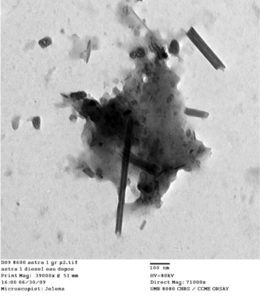 Carbon nanotubes (the long rods) and nanoparticles (the black clumps) appear in vehicle exhaust from tailpipes of cars in Paris.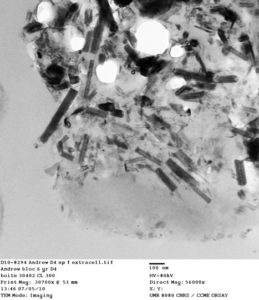
 More and more studies are finding negative health effects from hormone disrupting chemicals (which we are exposed to every single day, and subsequently which are in all of us), such as parabens, phthalates, Bisphenol-A (BPA), and chemical substitutes for BPA such as Bisphenol-S (BPS) and BPF. The
 A report released this week by the Endocrine Society states that the list of health problems that scientists can confidently link to exposure to hormone-disrupting chemicals has grown to include: diabetes, cardiovascular disease, obesity, reproductive and developmental problems, thyroid impairment, certain reproductive cancers, and neurodevelopmental problems such as decreased IQ. This statement (report) is based on the summaries of 1300 studies on endocrine disrupting chemicals (EDCs), and it also adds support to the idea that even
  Over and over studies find that a person's diet is linked to health and diseases, and now a study finds that an unhealthy diet is linked to shrinkage of the brain, specifically the volume of the left hippocampus. The biggest effects on the hippocampus are found with
  A recent post (